
What is Functional Music? How Specific Sound Frequencies Calm and Focus Your Brain
Functional music is designed for outcomes, not entertainment. Learn how brainwave entrainment, binaural beats, and sound design can help improve focus, relaxation, and sleep.
What is Functional Music? How Specific Sound Frequencies Calm and Focus Your Brain
Almost everyone has a popular music app on their phone. With it, you can listen to the latest hits at any time.
A few years ago, I would wear my headphones and listen to Taylor Swift’s youthful anthems like "Shake It Off" or "Anti-Hero" at night, or perhaps Beyoncé’s "Halo" or "Single Ladies"—the ultimate auditory indulgence.
What is functional music?
But sometimes, when I’m struggling with insomnia, these pop hits aren't exactly what I need.
When I need to fall asleep, I might listen to white noise or lullabies; when I'm working, I hope to hear light music in the office, just like working in a café. These sounds—which were not created for entertainment—are "functional music," designed to solve specific daily problems through sound.
What is functional music? It is less like "music" in the traditional sense and more like an "auditory remedy." It is meticulously designed to match your brain’s expected patterns through the specific arrangement of rhythm, frequency, and structure. It was created based on the theoretical foundations of neuroscience, psychoacoustics, and behavioral psychology.
So, how does it actually work? I will provide a detailed analysis below of how specific music impacts health.
Ⅰ. How does music affect your brain? Core concepts
To understand functional music deeply, you need to understand a few key phenomena in neuroscience:
Brainwave entrainment:
The conclusion here is that the brain tends to synchronize with external rhythms. If you listen to upbeat, fast-paced music, your heart rate and brainwave frequency will accelerate, making you more excited. Conversely, slow, low-frequency rhythms can induce a slower heart rate, helping you fall asleep more easily.
This theory is the cornerstone of functional music. It was proposed by renowned neuroscientist Lars-Olof Laurell and other researchers, and it is now widely applied in the field of "music therapy" within psychological counseling.
Rhythmic auditory stimulation can effectively 'entrain' neural oscillations, shifting the brain's internal frequency to match external acoustic rhythms, thereby modulating cognitive and emotional states.
Source: Thut, G., et al. (2011). "Entrainment of Periodically Oscillating Brain Activity." Frontiers in Psychology.
Binaural Beats:
This phenomenon was first introduced in 1973 by biophysicist Gerald Oster in Scientific American, and it is currently very popular for assisting with meditation and sleep.
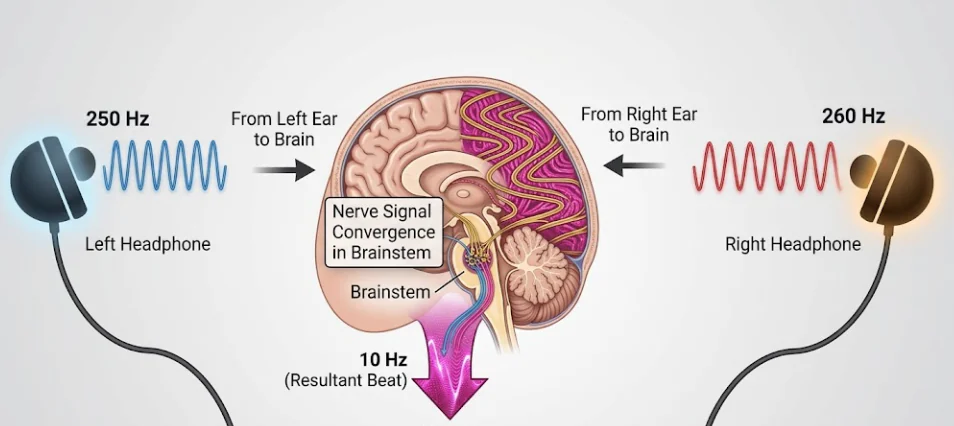
The perception of binaural beats involves the superior olivary complex, where the brain processes phase differences between ears to create a third 'phantom' frequency that encourages specific neural states.
Source:Oster, G. (1973). "Auditory Beats in the Brain." Scientific American.
When you listen with headphones, if your left ear hears a frequency of 400Hz and your right ear hears 410Hz, your ears hear two distinct tones, but your brain automatically "calculates" the difference. This creates a buzzing rhythmic sensation in your brain.
Brainwave Synchronization:
When binaural beats guide the brain to produce isochronic tones, the music leads the brain into specific frequency ranges. When specific music guides the brain into these frequencies, its functionality takes effect. The following ranges serve as a reference for brain activity:
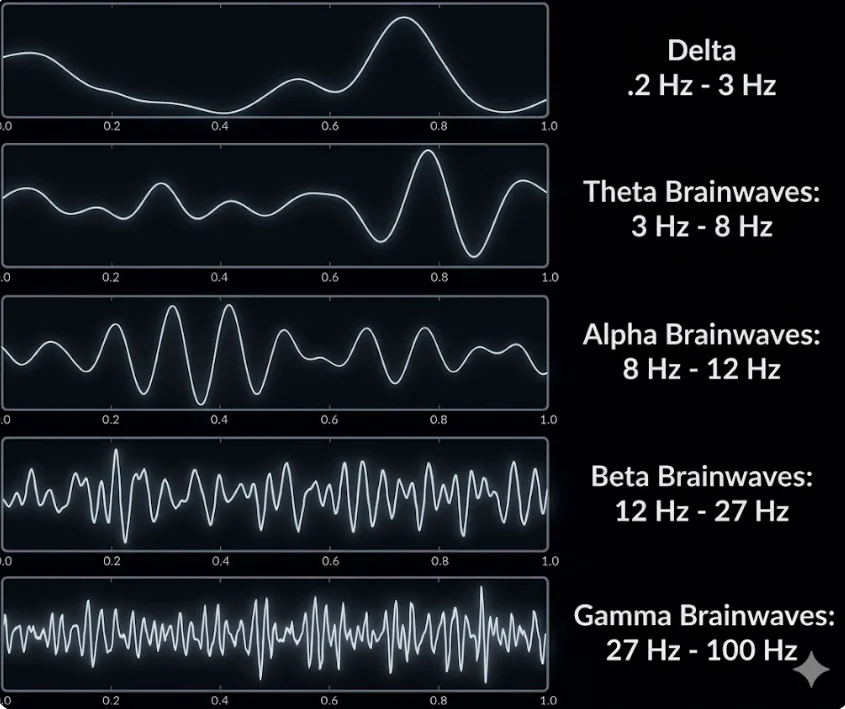
Gamma (30Hz+):
High focus, processing complex information.
Beta (13-30Hz):
Alert, thinking, vigilant.
Alpha (8-13Hz):
Relaxed, meditative, creative. (First discovered by Hans Berger, the inventor of the EEG).
Theta (4-8Hz):
Light sleep, deep relaxation.
Delta (0.5-4Hz):
Deep sleep, physical restoration.
Dopamine Regulation:
Cognitive neuroscientist Valorie Salimpoor from McGill University used PET scans to prove that when listening to music that produces pleasure, the brain's striatum releases dopamine. Dopamine acts as a "reward signal system," helping to improve mood and reduce anxiety.
Ⅱ.Types of functional music: The four core applications
Focus Music: Removes vocals and uses Alpha (8-13Hz) or Beta (13-30Hz) frequencies to build an "immersive learning soundscape."
Effect: Establishes a "Flow" state. For example, Lo-fi music can reduce distractions from the environment.
Functional soundscapes can reduce the 'signal-to-noise ratio' in the prefrontal cortex, facilitating the achievement of 'Flow'—a state of effortless concentration and peak performance."
Source: Csikszentmihalyi, M. (1990). "Flow: The Psychology of Optimal Experience."
De-stress Music: Lowers pitch and minimizes rhythmic changes, utilizing natural white noise or low-frequency pulses to help you enter "rest and digest" mode.
Effect: Lowers cortisol levels, slows the heart rate, and relieves tension.
Sleep Improvement Music: Uses extremely slow audio guided by Delta (0.5-4Hz) frequencies.

Effect: Shortens the time it takes to fall asleep, reduces pre-sleep anxiety, and increases the duration of deep sleep. Struggling to Fall Asleep? How Functional Music Guides Your Brain into Deep Sleep
Exercise Music: Uses high-frequency beats and accents to drive muscle movements and heart rate to a specific rhythm.
Effect: Maintains consistency in movement and psychologically masks fatigue during exercise.
Ⅲ.Why is it becoming a trend?
In today's content-saturated world, fragmented data and short-form media fight for every second of our attention, leading to significant cognitive exhaustion.People are becoming more exhausted than ever and are in greater need of controlling their own cognitive state.
For office workers, the constant chatter of open-plan offices or the chaos of daily commutes creates a desperate need for tranquility. Focus-enhancing music acts as an 'auditory barrier' for your mental health, shielding you from distractions and helping you maintain deep concentration.
Furthermore, when you are engaged in high-intensity mental labor for long periods, your brain often cannot "shut down" on its own. Functional music is the simplest intervention—you don’t need to learn complex meditation techniques; you just hit play to start regulating your emotions.
Ⅳ.How to choose "effective" functional music?
Avoid vocals: These activate the language center of the brain, increasing cognitive load.
Background music with lyrics has been shown to significantly impair reading comprehension and cognitive performance due to the 'irrelevant sound effect,' as the brain’s phonological loop becomes overloaded."
Source: Shih, Y. N., et al. (2012). "Effects of background music with different lyrics on reading comprehension." International Journal of Industrial Ergonomics.
Avoid large volume fluctuations: Keep away from overly complex or sudden melodic shifts.
However, because functional music needs vary by scenario and personal habit, you may need a player that tailors the experience to you. The AI-native functional music player Unrush is increasingly gaining attention.
Why is Unrush different?
My feeling is that it’s no longer just an ordinary player, but a dedicated AI music assistant. Unrush’s proud "Intent Engine" actively senses my state and provides precise, functional music.
Furthermore, the more I listen, the better it understands me. Every subtle bit of feedback I provide during use is fed back into the content arrangement, making the music increasingly aligned with my personal preferences.
Try it here: https://unrush.music/music