Struggling to Fall Asleep? How Functional Music Guides Your Brain into Deep Sleep
When sleeplessness keeps your brain in a high-frequency, hyper-alert state, functional music can help guide it toward slower rhythms that support deeper rest.
Struggling to Fall Asleep? How Functional Music Guides Your Brain into Deep Sleep
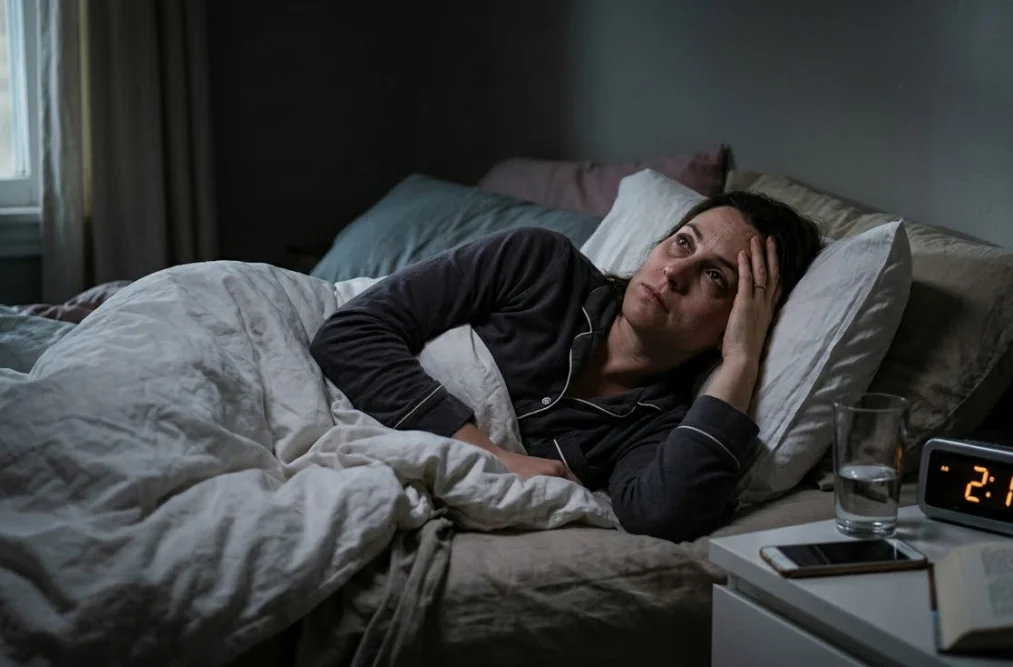
We’ve all experienced it: staring into the darkness at 2 AM, your mind whirring like a PC that won't power off.
When forcing sleep only backfires, stop struggling against your instincts and let functional music recalibrate your brainwaves for deep rest.
1. Struggling to Fall Asleep?
I believe everyone has experienced this scenario: you lie in bed, but no matter how you position yourself, you simply cannot fall asleep; instead, you feel more and more awake.
I have had similar experiences. One day, I "planned" to be asleep by 10 PM, but even after turning off my phone, I tossed and turned until 1 AM. Later, I realized that sleep doesn't seem to be something I can control. The more I wanted to sleep early, the later I actually fell asleep. At that time, my brain felt like a computer that couldn't shut down, and I felt the pain of insomnia.
Is sleep truly uncontrollable?How to Stop Insomnia? Indeed, if you force yourself to sleep, it often backfires. But if you input certain "commands" into your brain, sleep might become easier. After all, sleep is not just rest; it is a biochemical process evolved over millions of years.
Without relying on sleep aids, can we "force" ourselves into sleep by changing our brain's state? In recent years, scientists have discovered that music can achieve this—functional music (sleep music) can serve as a scientific alternative therapy.
2. Struggling to Fall Asleep? Understanding the Four Stages of Sleep
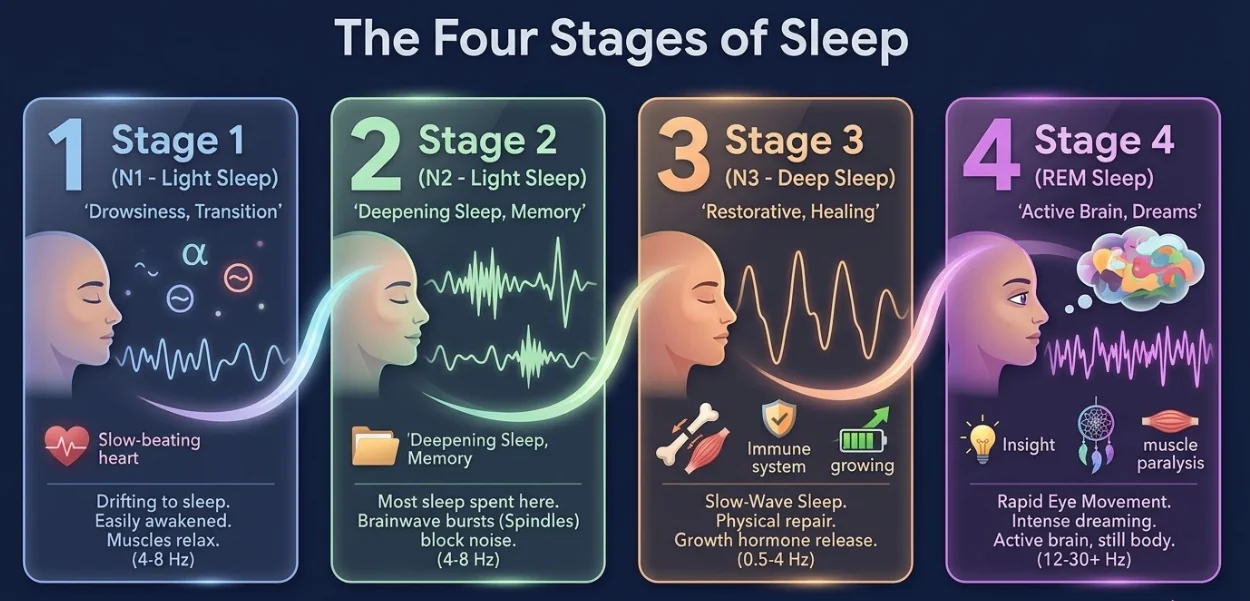
In 1968, Allan Rechtschaffen and Anthony Kales established the modern "standard" for sleep staging—the four stages of sleep.
Rechtschaffen, A., & Kales, A. (1968). A Manual of Standardized Terminology, Techniques and Scoring System for Sleep Stages of Human Subjects. Public Health Service, U.S. Government Printing Office.
The Four Stages of Sleep
NREM Stage 1 (N1 - Sleep Onset):
The shallow transition from wakefulness to sleep. Your muscles begin to relax, and your heart rate and breathing slow down, but you are easily awakened.
NREM Stage 2 (N2 - Light Sleep):
Status: This stage accounts for the largest portion of sleep.
Characteristics: Your brainwave frequency slows further, and "sleep spindles" and "K-complexes" appear; these can block external stimuli, helping you sleep more deeply.
NREM Stage 3 (N3 - Deep Sleep):
Status: Also known as "Slow-Wave Sleep."
Characteristics: Brainwaves are slow Delta waves. This is the stage hardest to wake from; if forced awake, you will feel groggy.
REM Stage 4 (Rapid Eye Movement):
Status: The main stage for dreaming.
Characteristics: Eyes move rapidly, and brainwave activity is nearly as active as when awake, but the body’s muscles are in a state of "paralysis."
3. Brainwave Frequencies During the Four Stages of Sleep
| Sleep Stage | Brainwave Name | Frequency (Hz) | Physiological Characteristics |
|---|---|---|---|
| N1 (Onset) | Alpha / Theta | 4 – 8 Hz | Frequency slows, Theta waves appear, accompanied by muscle twitches. |
| N2 (Light) | Theta / Spindles | 4 – 8 Hz | Appearance of "Sleep Spindles" and "K-complexes." |
| N3 (Deep) | Delta | 0.5 – 4 Hz | Very slow, large-amplitude "slow waves." A period of deep physical repair. |
| REM (Dreaming) | Mixed / Beta | 12 – 30 Hz | High and irregular frequency; brainwave patterns are extremely similar to being awake. |
4. Why Can Sound Frequencies in Functional Music Induce Sleep?
From the research above, we can see that sleep is essentially a process of the brain’s frequency constantly shifting downward: from 30Hz to 0.5Hz. To avoid insomnia, one must avoid stress stimuli, including inappropriate sound frequency interference, to prevent the brain from staying in a high-frequency state.
To enter N1 (Sleep Onset), Alpha/Theta waves (4–13Hz) help you begin to close your eyes and relax.
Through sleep music, you enter N2 (Light Sleep) with Theta waves (4–8Hz), where the brain begins to shield itself from external environmental distractions.
N3 (Deep Sleep) with Delta waves (0.5–4Hz) is the ideal deep sleep period. At this point, the brain enters its slowest frequency to perform systemic repair.
5. Why Can Sound Frequencies "Induce" Sleep?
The secret to inducing sleep lies in the neuroscience phenomenon of "Entrainment."
1) External frequencies as a "metronome"
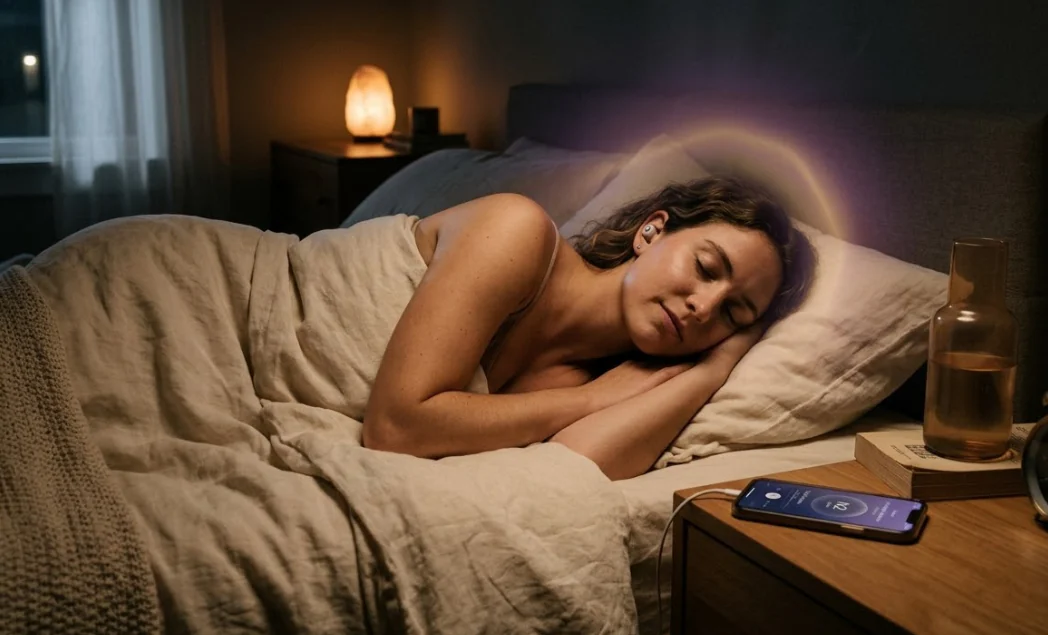
If your brain is in an anxious Beta state, natural sleep is quite difficult. However, you can try playing a steady, slow, low-frequency Delta wave tone through your headphones. Your brain’s neural firing will align with this rhythm due to "entrainment."
Thut, G., Schyns, P. G., & Gross, J. (2011). Entrainment of Periodically Oscillating Brain Activity in Physiological and Pathological States. Frontiers in Psychology.
2) The "smooth downshift" from Beta to Delta
You can use Theta wave frequencies (5–7Hz) to guide yourself into the N1 and N2 stages, allowing the brain to "quiet down" first, then gradually switch to Delta wave frequencies (0.5–3Hz) to slide the brain into N3 deep sleep. This "gentle induction" allows the brain to downshift smoothly rather than being force-shut down.
6. How to Stop Insomnia? The Advantages of Functional Music
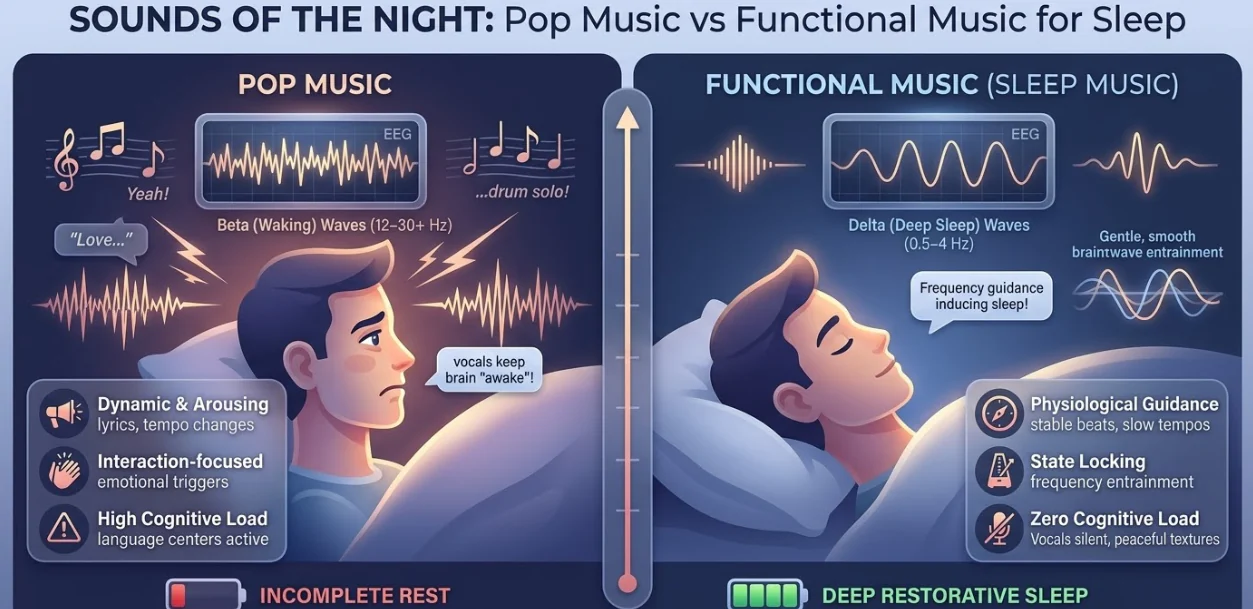
From the perspective of neuropsychology, pop music is designed for "arousal" and "interaction," which actually interferes with sleep.
Firstly, the vocals in pop music keep the brain in a "working mode," unable to shut down completely. Additionally, pop music arrangements contain sudden volume changes, drum bursts, and melodic climaxes; this "surprise" is the soul of pop music, but it prevents the brain from smoothly transitioning to the Delta band.
Pop Music VS Functional Music
| Comparison Dimension | Pop Music | Functional Music |
|---|---|---|
| Primary Function | Entertainment, emotional resonance, energy arousal | Physiological guidance, state resetting, state locking |
| Core Stimuli | Dynamic rhythm, lyrics, strong emotion | Stable beats, low-frequency pulses, frequency guidance |
| Brain Reaction | Language center activated, high cognitive load | Language center silent, extremely low cognitive load |
| Impact on Brainwaves | Maintains or elevates to Beta (Awake) | Guides to Theta/Delta (Deep Sleep) |
| Scenario Adaptability | Suitable for exercise, social, entertainment | Suitable for focus, meditation, deep sleep |
How Functional Music Guides Your Brain into Deep Sleep? Unrush: A Magical AI-Native Player I Discovered
Ordinary music player apps might actually interfere with sleep, and some traditional functional music apps have very rigid playlists that cannot adjust in real-time based on your "sleep status."
Since I started using Unrush, I discovered its unique advantages: when I am falling asleep, it can play white noise, and it can even subtly perceive my sleep rhythm to automatically adjust the frequency of the sleep music.
Since then, those nights of tossing and turning in insomnia have become increasingly rare, and I feel much more energized when I go to work the next day.
Try it out here: Unrush Music